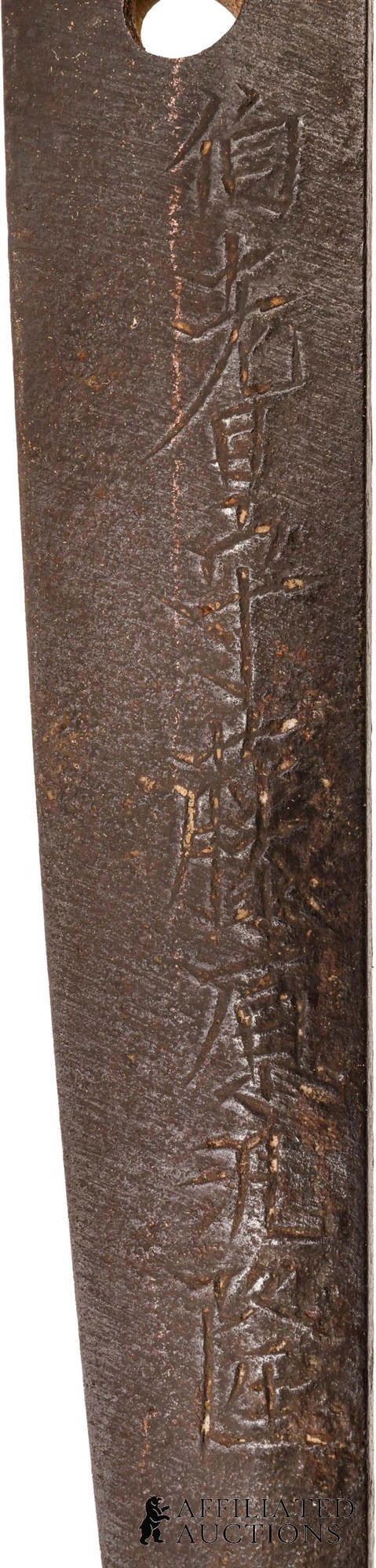

A katana forged by the master sword smith, Hoki no Kami Fujiwara Hirotaka. Fujiwara Hirotaka was a noted smith of the Meireki era (1655-1658), belonging to the Echizen Shimosaka school and apprenticing with Kanetane. He originated from Mino province and worked in Echizen Province under the Echizen Matsudaira clan. Hoki no Kami (Lord of Hoki) was a title granted to Fujiwara by the Shogunal government for superior craftsmanship. His works are generally noted as being Wazamono (exceptionally sharp) and generally treated at the Shinto Chujosaku grade (medium to high). As the blade is dated to 1655, it sits at an interesting intersection of Japanese history. Associated with the Echizen Matsudaira, themselves relatives of the Tokugawa Shoguns, the Matsudaira and other senior clans were severely damaged, and lost many of their ancestral weapons, in the Great Fire of Meireki in 1657, when a spreading urban fire combined with hurricane-level winds to engulf the central administrative district in flames. Ultimately, over a hundred thousand people were killed and the historical armories of Edo were destroyed, leaving this sword as a rare survivor from a particularly chaotic period in Japanese history. Adding to its history is the fact that this katana has been reset into the furniture for a Kyu-Gunto, the standard side arm used by the Imperial Japanese Army during the Russo-Japanese War prior to the advent of the Shin Gunto. The back of the grip features a small metal badge featuring a crane circle, the symbol of the Mori, albeit the Minamoto cadet clan as opposed to the clan associated with Mori Motonari. The blade possesses a pronounced and vibrant wavy hamon. Signed by smith. Tip of blade to tip of tang is a total 36.25 inches.
Condition
The Kyu-Gunto furniture is admittedly ill fitting, which makes sense for trying to fit a classic Japanese katana into standard industrial fittings.